> For the complete documentation index, see [llms.txt](https://docs.libum.io/nexum/llms.txt). Markdown versions of documentation pages are available by appending `.md` to page URLs; this page is available as [Markdown](https://docs.libum.io/nexum/symxchange/credentials.md).
# Credentials
{% hint style="info" %}
**Symitar eDocs References:** [Verification for SymXchange](https://learnmore.symitar.com/edocs/#xml/SymXchange/SymXchangeVerification_C.html), [SymXchange Credential Params](https://learnmore.symitar.com/edocs/#xml/SymXchange/SymXchangeCrdntlsParam_C.html), [SymXchange Per Operation Credentials](https://learnmore.symitar.com/edocs/#xml/SymXchange/SymXchangeCrdntlsParam_C.html)
{% endhint %}
With nearly every NexumAPI request, you will need to include the standard `Credentials` object you're accustomed to from SymXchange. Whether to provide [User Number](#user-number), or [Administrative](#administrative), etc. credentials depends on the configuration of each individual operation within a SymXchange service. We'll cover how to set that configuration in the next section.
## SymXchange Parameters
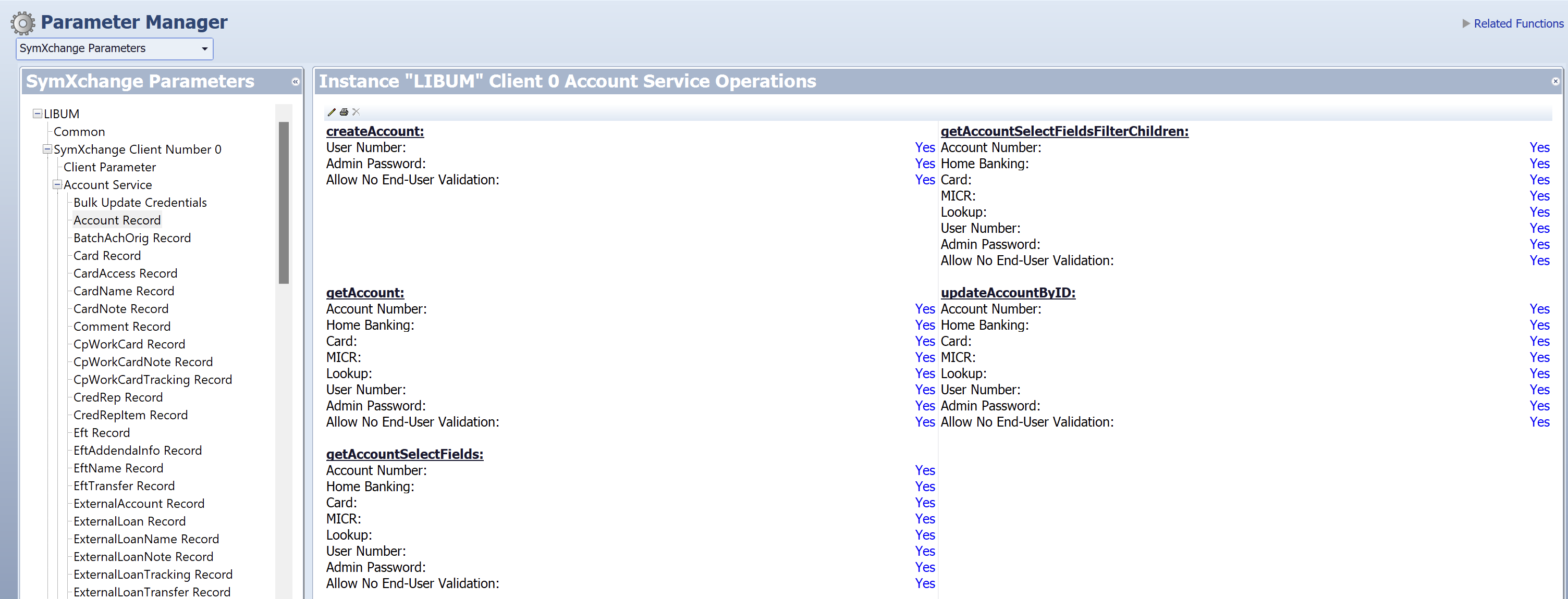
Any changes to the credentials of an operation will need to take place in *Parameter Manager > SymXchange Parameters* within Symitar Quest.
Parameter Manager in Symitar Quest configuring the SymXchange Account Service.
{% hint style="warning" %}
**Reminder:** Modifying any value in [Symxchange Parameters](#symxchange-parameters) will require the SymXchange instance to be restarted.
{% endhint %}
## Credential Types
The SymXchange operations can be authenticated with various types from within the `Credentials` object. The available credential types for each operation will vary and can be found in the [SymXchange API Reference](/nexum/symxchange/api-reference.md).
{% hint style="success" %}
**For NexumAPI Playground users:**
Each credential type below *should* work in our environment for their respective operation. If they don't, check out our [Help & Feedback](/nexum/resources/help-and-feedback.md) page for the best way to reach us!
{% endhint %}
### Account Number
The `AccountNumberCredentials` credential type can be used when returning account information from Symitar. To configure an operation to use this credential type, ensure that it's set to **Yes** for the target operation in [SymXchange Parameters](#symxchange-parameters).
```json
// Example works only for Account Number 13824
{
// ...
"Credentials": {
"AccountNumberCredentials": {
"AccountNumber": "0000013824",
"HomeBankingPassword": "Password123!"
}
}
}
```
### Home Banking
The `HomeBankingCredentials` credential type can be used when returning account information from Symitar for the home banking user. To configure an operation to use this credential type, ensure that it's set to **Yes** for the target operation in [SymXchange Parameters](#symxchange-parameters).
```json
// Example works only for Account Number 13824
{
// ...
"Credentials": {
"HomeBankingCredentials": {
"UserName": "TEST13824",
"Password": "Password123!"
}
}
}
```
### Card
The `CardCredentials` credential type can be used when returning account information from Symitar with an identical card number. To configure an operation to use this credential type, ensure that it's set to **Yes** for the target operation in [SymXchange Parameters](#symxchange-parameters).
```json
// Example works only for Account Number 13824
{
// ...
"Credentials": {
"CardCredentials": {
"CardNumber": "1234567891234567"
}
}
}
```
### MICR
The `MICRCredentials` credential type can be used when returning account information from Symitar with an identical MICR number. To configure an operation to use this credential type, ensure that it's set to **Yes** for the target operation in [SymXchange Parameters](#symxchange-parameters).
```json
// Example works only with Account Number 13826
{
// ...
"Credentials": {
"MICRCredentials": {
"MICRNumber": 12345678
}
}
}
```
### Lookup
The `LookupCredentials` credential type can be used when returning account information from Symitar with an identical Lookup Record and Home Banking Password. To configure an operation to use this credential type, ensure that it's set to **Yes** for the target operation in [SymXchange Parameters](#symxchange-parameters).
```json
// Example works only with Account Number 14117
{
// ...
"Credentials": {
"LookupCredentials": {
"Type": 0,
"Value": "TESTING",
"HomeBankingPassword": "Password123!"
}
}
}
```
### User Number
The `UserNumberCredentials` credential type is typically used when there needs to be user differentiation between requests. To configure an operation to use this credential type, ensure that it's set to **Yes** for the target operation in [SymXchange Parameters](#symxchange-parameters).
```json
{
// ...
"Credentials": {
"UserNumberCredentials": {
"UserNumber": 1995,
"Password": "thiswillwerkOP00!"
}
}
}
```
### Administrative
The `AdministrativeCredentials` credential type is typically used by applications as a general authentication standard which is accepted by auditors when it's coupled identifying transactions and File Maintenance (FM) via `ProcessorUser`. To configure an operation to use this credential type, ensure that it's set to **Yes** for the target operation in [SymXchange Parameters](#symxchange-parameters).
Additionally, you will need to make sure that there is an **Administrative Password** set in the Client Parameters.
{% hint style="info" %}
**ProcessorUser:** Including `ProcessorUser` within the `Credentials` block will assign its value to the attributes of the request payload. This is how the user is identified in FM History for any transactions or File Maintenance performed by the request.
{% endhint %}
```json
{
// ...
"Credentials": {
"AdministrativeCredentials": {
"Password": "suwn37834b91&"
},
"ProcessorUser": "YourProcessorUser"
}
}
```
### Token
The `TokenCredentials` credential type is used with the [UserManagementService](https://github.com/libum-llc/corporate-docs/tree/main/src/nexum/symxchange/api-reference/usermanagementservice.md). After a successful `logon` request, a `TokenId` will be returned that can be provided to any operation that's configured to use it. To configure an operation to use this credential type, ensure that it's set to **Yes** for the target operation in [SymXchange Parameters](#symxchange-parameters).
```json
{
// ...
"Credentials": {
"TokenId": "iEG+nkqW+Qi3RfTt0STT3QYgxoM4p3ZCqPXI7Ibkg1d5ExB98ottVJJTByff6Kz0WETI1aR03AJZkev5O3J0Cg=="
}
}
```
{% hint style="warning" %}
**Reminder:** The `TokenId` used in this example is just an example. After a successful login for a user, you'll receive one and it will expire in 15 minutes.
{% endhint %}
---
# Agent Instructions
This documentation is published with GitBook. GitBook is the documentation platform designed so that both humans and AI agents can read, navigate, and reason over technical content effectively. Learn more at gitbook.com.
## Querying This Documentation
If you need additional information that is not directly available in this page, you can query the documentation dynamically by asking a question.
Perform an HTTP GET request on the current page URL with the `ask` query parameter, and the optional `goal` query parameter:
```
GET https://docs.libum.io/nexum/symxchange/credentials.md?ask=&goal=
```
`ask` is the immediate question: it should be specific, self-contained, and written in natural language.
`goal` is optional and describes the broader end goal you are ultimately trying to accomplish on behalf of the user. GitBook uses it to tailor the answer towards what is most useful for that goal.
The response will contain a direct answer to the question and relevant excerpts and sources from the documentation.
Use this mechanism when the answer is not explicitly present in the current page, you need clarification or additional context, or you want to retrieve related documentation sections.